

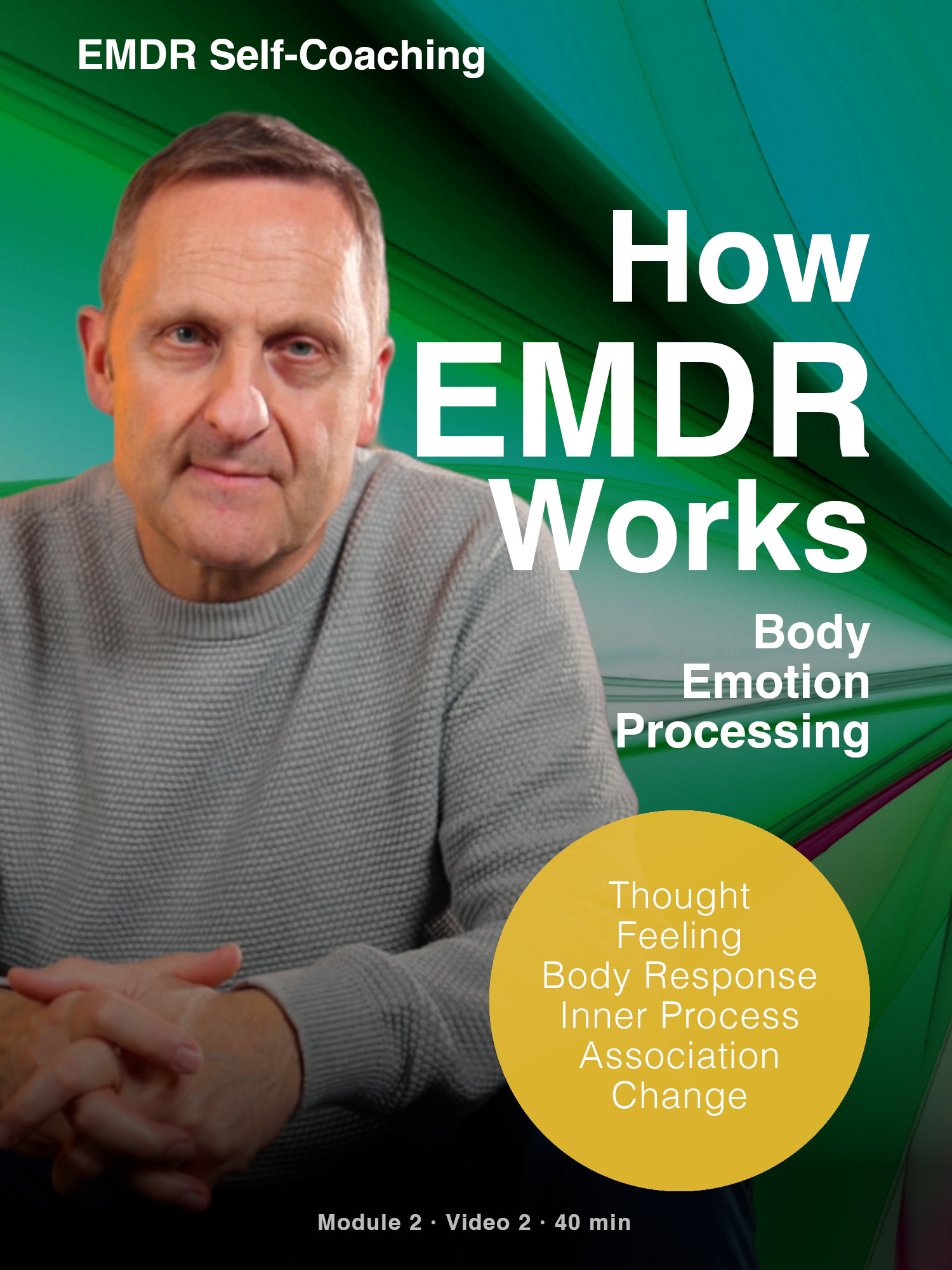
The Mechanics Behind Processing – and Why It Needs to Be Understood
After the first module laid the groundwork, the next question inevitably arises: How exactly does EMDR work? What happens in the brain when a distressing memory is activated, and why can it change over time?
Without this clarification, EMDR remains a method that can be applied, but whose effect is not truly comprehensible. This is where this module comes in. It delves deeper into the mechanics of processing and reveals what happens in the background.
How Memories Are Formed, Persist, and Are Reactivated
Distressing experiences are not simply stored neutrally in the brain. They are linked to emotions, bodily reactions, and evaluations. This connection means that certain memories can remain active long after the original event.
In everyday life, this often manifests as reactions that don’t fully fit the current situation. Certain stimuli are enough to trigger the original emotional charge again. This happens automatically, not consciously controlled.
EMDR intervenes precisely at this point. The process utilizes the brain’s ability to reprocess activated content. However, for this to be possible, certain conditions must be met. The memory must be accessible, attention must remain stable, and processing must not be interrupted.
Exactly these connections are made understandable in this module.
Why Processing Is Possible – and What It Depends On
A central point that often remains unclear is why a memory can change at all. The experience itself cannot be undone, yet the way it is anchored in one’s experience can change.
The crucial difference lies in processing. While distressing content often remains isolated and incompletely integrated, EMDR allows for subsequent integration into existing experience structures.
For this process to begin, the brain needs to meet several requirements simultaneously. The memory is activated while attention is maintained within a stable framework. At the same time, a form of distance is created, allowing the content to be processed without being completely overwhelmed by it again.
This balance is no coincidence. It is the foundation for change to become possible at all. If it is not achieved, processing either fails to occur or is prematurely interrupted.
This module makes these conditions comprehensible and shows how to recognize whether a process is in motion or not.
The Significance for Practical Application – and the Transition to the Next Step
Understanding the mechanism of action fundamentally changes the perspective on its application. EMDR is then no longer a sequence of steps, but a process that can be specifically supported.
This is precisely where the benefit of this module lies. It creates the connection between theoretical understanding and subsequent implementation. Those who know what is happening in the background can better classify and more purposefully apply the following steps.
The structure of this tutorial emerged from practical work with EMDR. Over many years, it has become clear that effectiveness largely depends on whether the underlying mechanisms are understood. Based on this experience, the structure was chosen so that each step logically builds on the previous one.
With this understanding, it becomes clear why the specific execution of eye movements plays a central role in the next module. The external stimulation is not a minor component, but a decisive factor in whether the described processes are actually initiated.
This module thus creates the prerequisite for understanding the next step not in isolation, but in connection with the entire processing cycle. Read more about Module 3.1…