

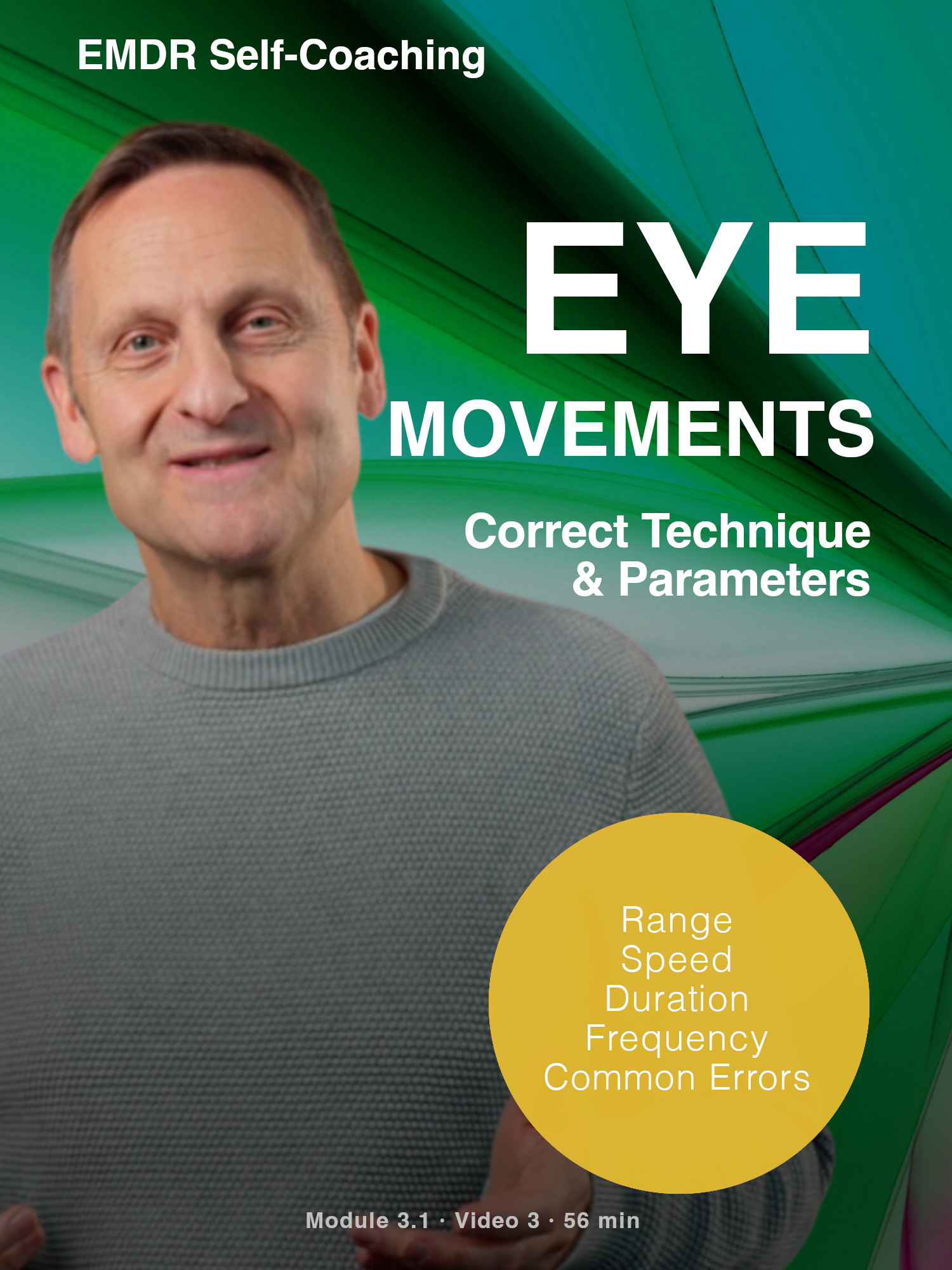
The crucial part of the application – and why precision makes all the difference here
After the second module made the mechanism of action of EMDR comprehensible, the focus now shifts to the part that is most visible from the outside and at the same time most frequently underestimated: the eye movements.
At first glance, they seem simple. The gaze moves, attention follows. This easily creates the impression that they are an interchangeable component that can be arbitrarily replaced or simplified.
This is precisely where the biggest differences in application quality arise.
This module addresses this point. It clarifies what function the eye movements actually fulfill in the overall process and why their execution is not incidental, but must be precisely understood.
Why the execution of eye movements is more than an accompanying element
In the context of EMDR, eye movements are often viewed as a mere aid. They seem to accompany the process without significantly influencing it.
This assessment falls short.
The way eye movements are implemented has a direct influence on whether the processes described in the previous module are initiated at all. They do not work in isolation, but in connection with activation, attention, and internal processing.
What matters is not how the movement is triggered, but how it is integrated into the sequence. Whether with open or closed eyes, with external orientation or purely internal guidance – the quality of execution determines whether the process is stably supported.
This module makes these connections comprehensible without limiting itself to simplified representations.
Common misconceptions – and why they impair the process
Precisely because eye movements appear so accessible, many simplified assumptions have developed in dealing with them.
This includes the notion that speed, rhythm, or range of movement play only a minor role. Equally widespread is the assumption that any form of movement is fundamentally sufficient as long as it is somehow present.
In practical application, however, a different picture emerges.
Certain deviations cause the process to become unstable or not get started at all. Others alter perception in such a way that the actual processing is overshadowed.
These effects are not immediately obvious, but they directly affect the outcome.
This module addresses these points and systematically categorizes them, making it clear what matters and which aspects are not arbitrary.
The foundation for precise application – and the transition to the next step
The goal of this module is not mechanical imitation of sequences, but a clear understanding of what role eye movements play in the overall process.
Those who recognize this connection can design the implementation of eye movements more purposefully and better assess their own perception during application. This creates a significantly more stable foundation for the following steps.
The structure of this tutorial also follows practical experience here. Over a longer period, it has become clear that this area in particular is often simplified and thereby loses effectiveness. For this reason, it is deliberately treated in depth at this point.
With this understanding, it becomes comprehensible why in the next module the concrete implementation is transferred into a clear, step-by-step structure. The sequences described there directly draw on the knowledge conveyed here and make it usable in application.
This module thus forms the connection between the theoretical mechanism of action and practical implementation. It ensures that the following steps are not perceived in isolation, but understood as part of a coherent process. Read more about Module 3.2…