

EMDR – Access to Emotions, the Body, and Change
EMDR is one of the most effective methods for directly addressing emotional processes and bringing about lasting change. The focus is not on thoughts or explanations, but on what actually has an impact on our experience: emotions, physical reactions, and the connections within our emotional memory.
That is exactly where change happens.
While many approaches focus on knowledge, insight, and new strategies, EMDR takes a different approach. It draws on the brain’s ability to reprocess and reframe activated experiences. Traumatic experiences are not only understood, but their emotional impact is also altered.
What makes this special is that this process does not depend on whether everything is understood logically. Even skepticism, inner resistance, or uncertainty do not stand in the way of its effective application, as long as the process is clearly structured and carried out correctly.
The focus is on the interplay between memory, emotion, and the body. What often happens automatically in everyday life is deliberately set in motion through EMDR. This is precisely what gives the method its intensity and effectiveness.
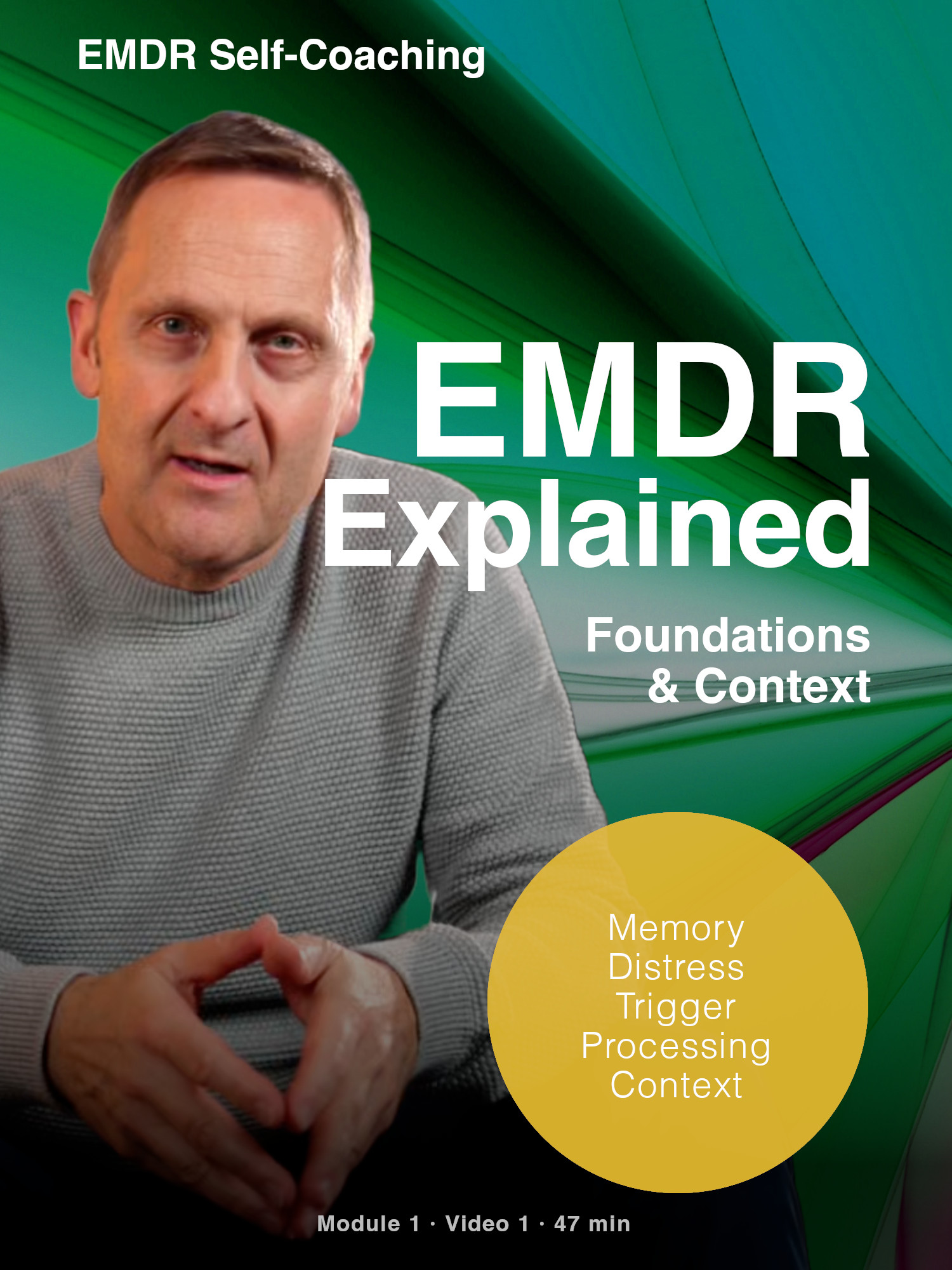
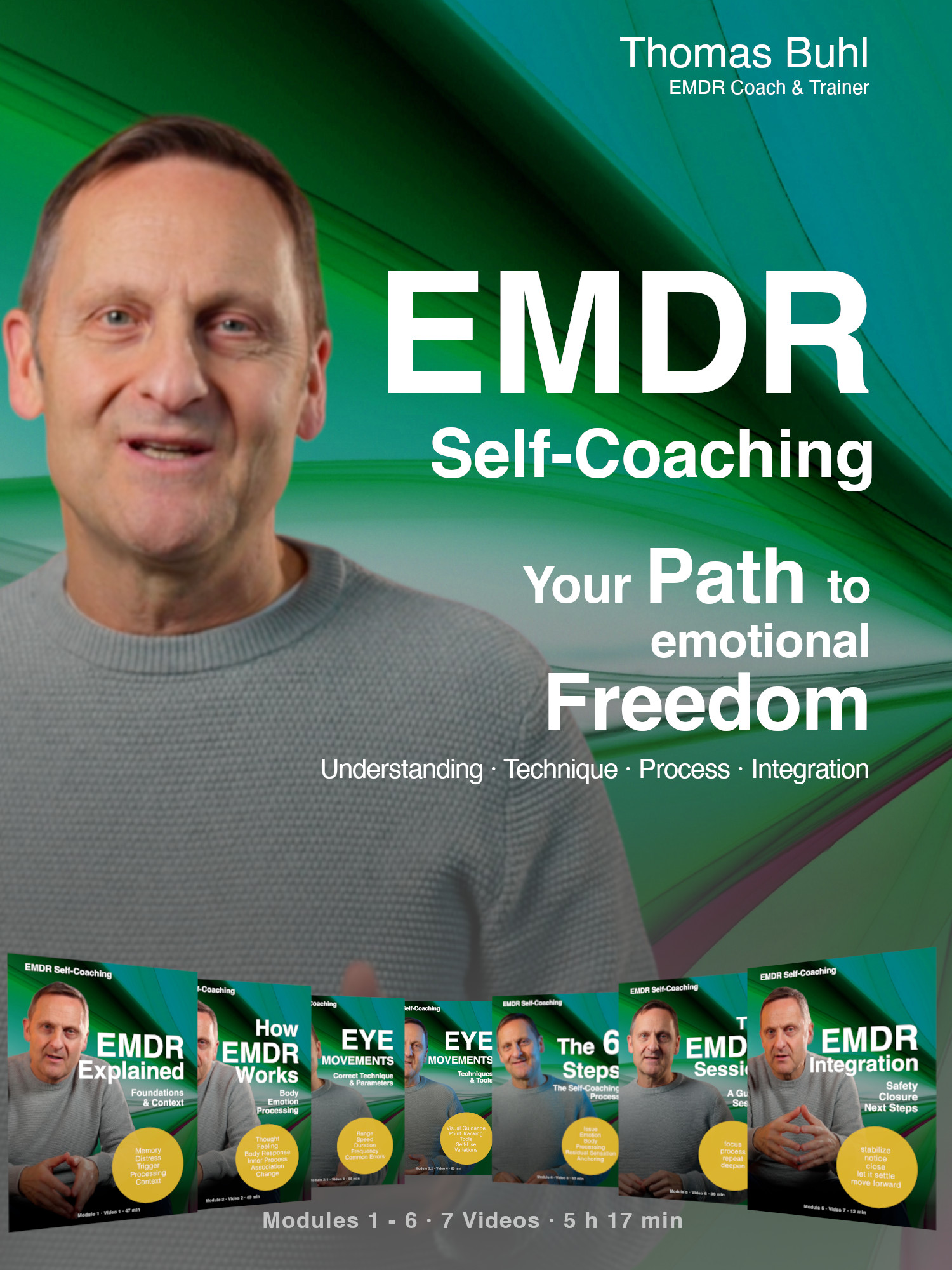
This video tutorial applies this approach to self-coaching—not as an abstract guide, but as a direct, guided experience. The content is not merely explained, but is conveyed, spoken, demonstrated, and guided step-by-step throughout the video. This creates a form of guidance that goes beyond mere information.
It is based on nearly two decades of practical experience with EMDR gained by Thomas Buhl, a naturopathic practitioner specializing in psychotherapy as well as an EMDR and trauma therapist. Over this time, it has become clear time and again that the method is most effective when it is fully understood and precisely applied. In contrast, simplified approaches and isolated techniques often lead to unreliable results.
One aspect is particularly important in this context.
In recent years, as part of practical work with EMDR, efforts have been focused on developing technical solutions to support visual stimulation. This has led, among other things, to the development of the REMSTIM 3000 EMDR glasses and the REMSTIM 4000 professional desktop unit.
These developments had a clear goal: to stabilize the quality of the application and ensure the process ran reliably.
At the same time, our day-to-day work has repeatedly shown that another factor is even more crucial.
It is not the tool itself that determines its effectiveness, but rather an understanding of the process and the ability to implement it correctly.
Many people want to work independently. Others do not have access to the necessary equipment or consciously choose not to use it. In all these cases, the central question remains: How can EMDR be taught in a way that allows it to be applied independently and reliably?
That is exactly why this video tutorial was created.
It was deliberately designed so that it can be used entirely without technical aids. The focus is on what actually underpins the method: structure, process, and precise implementation.
Anyone who understands this process and applies it correctly will be able to use EMDR on their own for self-coaching.
For this reason, this tutorial was not structured as a collection of individual exercises, but rather as a continuous, guided process. From a basic understanding of the mechanics and proper execution to direct application and integration, a structure is established that is guided step by step in the video.
The goal is not to explain EMDR. The goal is to build the ability to confidently apply the EMDR process on your own—guided by clear instructions that come to life in the video.
The video tutorial serves as a pre-recorded digital self-study course that guides you through the material. You can work through the individual video lessons independently and at your own pace. Individual support, testing, personalized feedback, or progress tracking are not included in this offering.
Module 1 – Fundamentals and Context (watch for free here: >>)
 This tutorial does not begin immediately with practical application, but rather with a clear understanding of what is actually happening behind the scenes. EMDR is often perceived through visible elements—eye movements, external stimuli, and seemingly simple procedures. What often remains unclear, however, is the structure within which these elements operate.
This is exactly where this module comes in.
It explains how traumatic experiences are stored within the inner system and why they continue to influence our daily lives. This is not about abstract theory, but rather about a framework that is directly connected to one’s own personal experience. Triggers, emotional reactions, and internal connections are placed within a context that is both understandable and practically relevant.
A key point is to clearly recognize the difference between understanding and processing. Many processes continue even though they have long since been cognitively understood. This module explains why this is the case—and under what conditions real change becomes possible.
This creates a foundation that is crucial for all subsequent steps. Without this context, the application remains vague. With it, the process becomes transparent and can be utilized in a targeted manner. Read more about Module 1…
Module 2 – Mechanisms of Action and Internal Processes
 Now that the foundation has been laid in the first module, this chapter takes a crucial step further: It reveals what actually happens internally during an EMDR process. Without this understanding, the application often remains mechanical—and thus limited in its effectiveness.
The central question is why traumatic experiences persist in the first place and why they are repeatedly triggered in everyday life. Memories are not stored neutrally. They are linked to emotions, physical reactions, and internal evaluations. It is precisely these connections that determine how a situation is experienced—often regardless of whether it is still logically relevant.
EMDR utilizes the brain’s ability to reprocess activated content. What is crucial here is not the memory itself, but the state in which it is processed. This module explains the conditions under which this state arises and how it can be recognized.
This fundamentally changes the way we view the application. EMDR is no longer understood as a technique, but rather as a process that can be specifically supported. This framework creates the conditions not only for carrying out the following steps, but also for understanding their effects. Read more about Module 2…
Module 3.1 – Eye Movements as a Key Element
 This module focuses on the aspect of EMDR that is most visible—and yet most frequently underestimated: eye movements. At first glance, they seem simple, but they are crucial to whether the process even gets underway.
The quality of eye movements directly determines the quality of processing. Speed, rhythm, and amplitude are not secondary factors, but rather key parameters that determine whether the internal process remains stable or stalls.
This module explains the actual role that eye movements play in the overall process. They are not merely an accompanying element, but rather the trigger for the bilateral stimulation that supports the processing. If this part is not performed accurately, the effect can be significantly reduced or completely prevented.
At the same time, common misconceptions are addressed. Simplified assumptions—such as the idea that any form of exercise is sufficient—often lead to unclear results in practice.
This provides a precise foundation for further implementation. Eye movements are no longer simply performed, but are consciously employed—as a central component of a functioning process. Read more about Module 3.1…
Module 3.2 – Implementation and Application of Eye Movements
 Building on an understanding of eye movements, this module takes the next step toward practical application. This is where the transition from understanding to putting it into practice begins.
The program is structured in such a way that it is immediately understandable and easy to implement. Various forms of visual stimulation are organized in a way that makes their respective effects clear.
A key aspect of this module is hands-on experience. The application isn’t just theoretical; instead, it’s carried out together in the video. This helps participants develop a sense, even during the module, of how different variations feel and which approach works consistently well.
At the same time, a conscious decision has been made not to tie the program to any specific aids. The program is designed so that it can be started at any time as part of daily life.
This transforms an understanding into a first personal experience. It is precisely this transition that forms the foundation for the next steps. Read more about Module 3.2…
Module 4 – The Structured Process of EMDR Self-Coaching
 Once the individual elements have been understood and put into practical context, this module brings them together into a clear, coherent process. It is only through this structure that an application is created that functions reliably and can be replicated.
The process is based on six sequential steps that together form the framework for self-coaching. Beginning with the selection of a specific topic, attention is deliberately directed toward emotions and physical sensations. Building on this, the actual processing begins, supported by repeated phases of stimulation.
As the process continues, any remaining sensations are acknowledged and integrated into the process before a transformed inner state is finally stabilized.
This structure is not only explained in the video but also demonstrated. Transitions do not arise theoretically; rather, they can be experienced as part of the process. This results in a form of application that is significantly more stable than a purely conceptual implementation.
This provides guidance throughout the process and ensures confidence in its execution. Read more about Module 4…
Module 5 – The Guided Application
 In this module, the process developed earlier is fully translated into a hands-on experience. Understanding and preparation give rise to a concrete application, which is guided step by step in the video.
The six steps of self-coaching are worked through in sequence. This creates a continuous guiding thread that supports the process and keeps it on track. Attention is maintained, transitions are guided, and the process keeps moving forward.
This form of instruction has a special quality. The exercise is not merely described but experienced firsthand. The guidance is provided through the spoken instructions, allowing participants to fully immerse themselves in their own experience.
A key aspect here is duration. The process is given sufficient time to unfold. Change does not result from isolated impulses, but rather from the continuous progression through the individual phases.
This means that EMDR is no longer simply explained, but its effects can be experienced firsthand. Read more about Module 5…
Module 6 – Integration and Conclusion
 After the session comes a step that is often underestimated but is crucial for lasting results: the conscious integration of the experience.
This module brings together the key content of the tutorial and places it within a broader context. It becomes clear how the individual elements interrelate and why their interaction, in particular, determines the impact of the entire process.
In addition, the post-treatment phase is addressed. Changes often continue in the aftermath. Thoughts, emotions, and physical sensations can continue to evolve and reorganize themselves.
This module deliberately brings the process to a close. At the same time, it creates a structure that can be reused at any time.
This results not only in a single experience, but in a skill that can be applied repeatedly in everyday life. Read more about Module 6…
Resources and Expertise – A Practical Perspective
The following content is based on many years of practical experience with EMDR—and on a very thorough examination of visual stimulation itself.
Over a period of about 17 years, Thomas Buhl specifically developed and implemented systems in his practical work to ensure that the quality of eye movements remained stable and reproducible: the REMSTIM 3000, a portable system for self-coaching, and the REMSTIM 4000, a stationary solution for professional use.
This ongoing practice has led to a nuanced understanding of the key parameters. Speed, amplitude, duration, and repetition do not act in isolation, but rather in interaction with one another. It is precisely this interaction that determines whether a process gets off to a stable start, intensifies, or loses its effectiveness.
This experience is directly incorporated into the structure of this tutorial. The classification of eye movements, their role in the overall process, and their practical application have been developed based on this hands-on work and are structured with corresponding precision.
The application is intentionally designed to work without technical aids. What matters most is understanding the process and performing it correctly—that is the focus of this tutorial.
Closing – A Comprehensive Process
This video tutorial provides a step-by-step, guided walkthrough.
From the classification and mechanism of action, to the precise execution of eye movements and the clear structure of the self-coaching process, all the way to direct application and integration, a coherent process emerges that can be used independently.
It’s not just about individual techniques.
It is about the ability to consciously perceive inner processes, to set them in motion in a targeted way, and to transform them into a new form.
This skill is not developed through a single instance of understanding, but through experience and repetition.
After completing this video tutorial, you’ll be able to use the method independently for self-coaching right away. You can start putting it into practice immediately—without any technical aids—thanks to the clarity of the process and your confidence in carrying it out.
This provides a framework that can be revisited at any time.
Whether to take this path is, of course, a personal decision.