


When you review completed work repeatedly, distinguish between a new, objective observation and a renewed need for reassurance. Necessary checks remain important; however, repeating the same review without new information will not address every concern. EMDR Self-Coaching can be applied when daily stress is manageable, focusing on the moment the urge to check arises: the thought that you may have overlooked something and the associated tension. Severely restrictive or compulsive checking requires professional evaluation.

The accounting is done; the receipts have been sorted and filed. You stand up, reach for your jacket, and pause. Was that one receipt really in there? You pull the folder out again. It’s in the right place. Back on the shelf, another possible doubt crosses your mind.
There’s nothing new to work on right now. Still, walking away feels like being careless. Maybe your hands get restless, and you want to check one more time. Not to make the report look better, but to finally be sure you haven’t forgotten anything.
What will you know after the next checkup?
This question helps narrow down the process. An audit has a specific reason—for example, if an amount doesn’t add up, a receipt is missing, or new feedback reveals an error. Then you examine a specific point and can determine what information will resolve the issue.
When you check again, however, the same possibility may remain open each time: Perhaps you’ve overlooked something despite your previous review. You don’t find any new mistakes, but the relief is short-lived. Then you have to repeat the same process—something that still doesn’t feel entirely reliable to you.
This is an observation, not a diagnosis. Look at a specific, completed process: What prompted the last check? What did you find during it? Has anything actually been added since then? If so, this observation warrants attention. If not, the lingering uncertainty itself becomes the issue.
For safety-related tasks, mandatory inspections and technical standards apply regardless of this difference. Advice to perform inspections less frequently must never mean skipping necessary checks.
The work is done, but the inner mission is not yet complete
Perhaps this task is: “I can’t leave until I’ve ruled out every doubt.” This means that completion no longer depends solely on the result of your work. It depends on a feeling of complete certainty. If unease resurfaces, it’s a sign that you can’t be finished yet.
In this example, the thought of the receipt sparks an impulse to act. You sense uncertainty, pause in the hallway, and turn back toward the shelf. The folder serves as the visible point of reference; your inner reaction plays a part in determining whether you can leave it alone.
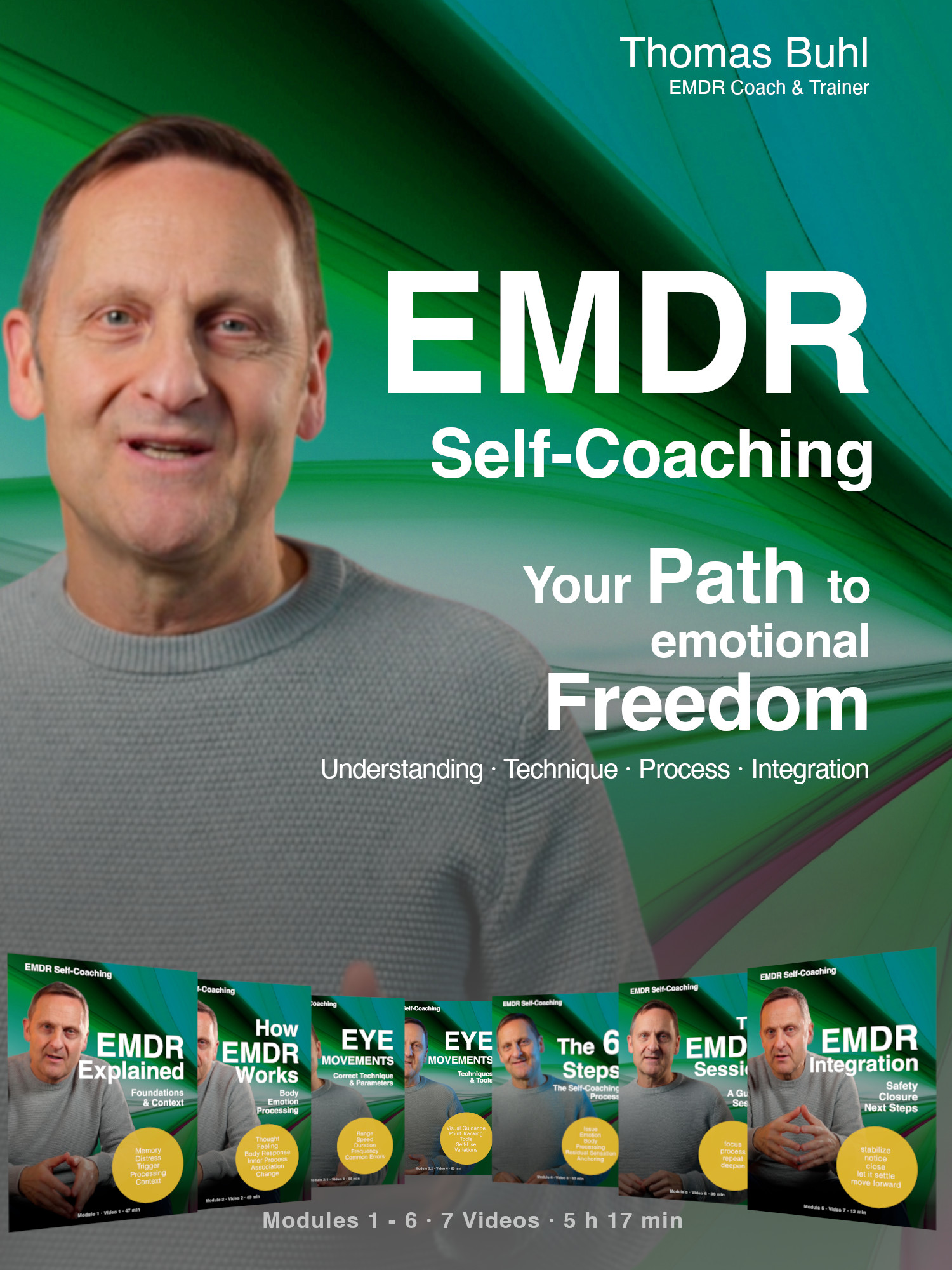
In his self-developed six-step EMDR self-coaching program, Thomas Buhl focuses on these connections between a specific issue, the associated emotion, and the physical experience. The factual question of whether the bill is correct remains separate from this. A feeling alone is neither proof of an error nor confirmation of quality.
Seize the moment before you look again
For inner work, the scene can be narrowed down to “I don’t want to control everything anymore.” You’re standing in front of the filed-away folder, thinking, “I’m sure I missed something,” and noticing the urge to open it again. Maybe this involves worry, maybe a knot in your stomach. Just describe what you’re actually sensing.
This limited reaction can be a topic for self-administered EMDR, provided it is not pathological and you can manage it well. In Buhl’s protocol, the chosen topic is linked to emotion, bodily sensations, and bilateral stimulation. Afterward, you assess whether and how the experience has changed.
The point here isn’t to convince you that there is definitely no error. Nor is the app meant to become an additional mandatory check: first do some self-coaching, then you can exit the process. This inner work has its own framework and is not a substitute for a professional review.
If you want to use EMDR on your own, you should first familiarize yourself with the complete process and its limitations. The description of this scene is not a guide for conducting a session. If you feel overwhelmed, you may stop and seek support; severe or traumatic stressors should not be addressed through self-administered EMDR.
When Self-Coaching Isn’t the Right Answer
If checking things takes up a large part of your day, is difficult to stop, or significantly limits your daily life, it’s a good idea to seek a professional evaluation. You don’t have to decide on your own whether you already have an obsessive-compulsive disorder. Nor can this be determined by the number of times you check things.
Don’t try to address this pattern with self-imposed restrictions or more and more self-coaching. The perspective described here applies to manageable everyday situations, not as a treatment for severe compulsions.
A real clue can bring you back
As for the matter that has been set aside, a clear distinction remains: New, objective information may call for further examination. Doubt that simply resurfaces is, at first, an internal reaction. You may acknowledge both without equating them.
Just because the necessary checks have been completed doesn’t mean that every last possible uncertainty has been eliminated. You can leave the folder as is. And if a discrepancy does arise later, you can address that specific issue instead of opening up the entire project over and over again as a precaution.