


You’ve realized for yourself that you want to break free from this relationship. Then a loving message comes along, and suddenly that hope—the same hope that has kept you from leaving so many times before—is back. Your decision can remain firm at its core, even as you continue to feel connected. Love, fond memories, guilt, or fear don’t just disappear with a decision. Letting go emotionally begins with distinguishing more clearly what is holding you back right now.

This is about that inner ambivalence that arises after making a fundamental decision. In cases of violence, threats, stalking, coercion, or excessive control, you need appropriate protection and counseling services. Self-coaching cannot replace these services. In cases of immediate danger, dial 110 in Germany; women affected by violence can reach the “Violence Against Women” helpline at 116 016—available 24/7, free of charge, and anonymously if desired.
A sense of connection doesn’t end just because you’ve realized something
Maybe you miss the closeness that was possible between you two. Maybe you love certain qualities about this person, even though being around them is stressful for you. Both feelings can coexist. The fact that you miss someone or think about the good times you shared doesn’t automatically invalidate the reasons behind your decision.
That doesn’t mean you have to talk down the good memories. A wonderful vacation can indeed have been wonderful, while constantly belittling it in everyday life is still unacceptable. If you accept only one of these perspectives, you’ll have to reevaluate the entire story with every new memory. The more accurate approach is to acknowledge both experiences.
Hope is sometimes directed toward what is yet to come
A conciliatory gesture can tie in with the idea: “This is how things could be between us.” At that moment, you may be less concerned with your everyday life up to that point than with the relationship you’ve been hoping for. You don’t want to give up on the possibility that a few good moments could turn into a reliable relationship.
This hope is understandable. However, it does not yet constitute an observed change. You can notice what the gesture triggers within you, while at the same time sticking to what you know about how things have gone so far. To do this, you don’t need to go over all the reasons for staying or leaving again at this very moment.
Instead, ask yourself what you’re missing right now: the person, a familiar routine, or the prospect of a future together? The answers may vary. This makes it clearer why the same decision seems clear one day and emotionally almost impossible to carry out on another.
Distinguishing Between Guilt and Practical Responsibility
“I’m letting someone down” can weigh more heavily than the reason why you want to end the relationship. However, compassion does not obligate you to continue a relationship against your will. At the same time, there may be specific shared obligations for which you need support and clear guidance.
A living situation, financial dependence, or responsibility for shared children is not just a thought you need to overcome on your own. Social, legal, or other professional counseling services may be necessary. Feeling anxious about such unresolved issues does not mean that you just need to try harder emotionally.
So make this distinction: What actually needs to be clarified? And what additional self-reproach is involved? “We need a reliable arrangement” describes a task. “I’m a bad person if I leave” is a sweeping judgment about yourself. Both require a different approach.
Find the one situation in which your resolve wavers
If your situation is safe, you can take a closer look at the moment that’s causing you to withdraw emotionally. Maybe it’s the message with the familiar term of endearment. You think, “Now I’m really going to let him down,” feel guilty, and want to reassure him right away that everything will be all right. You might feel a tightness in your throat; or perhaps you don’t notice any distinct physical sensation.
This describes a specific reaction. You don’t have to explain your entire relationship or make all your feelings for the other person disappear. A conversation with someone you trust can start right here: “When I get this message, I briefly forget why I want some distance.” That’s more concrete than the accusation that you’re simply too weak.
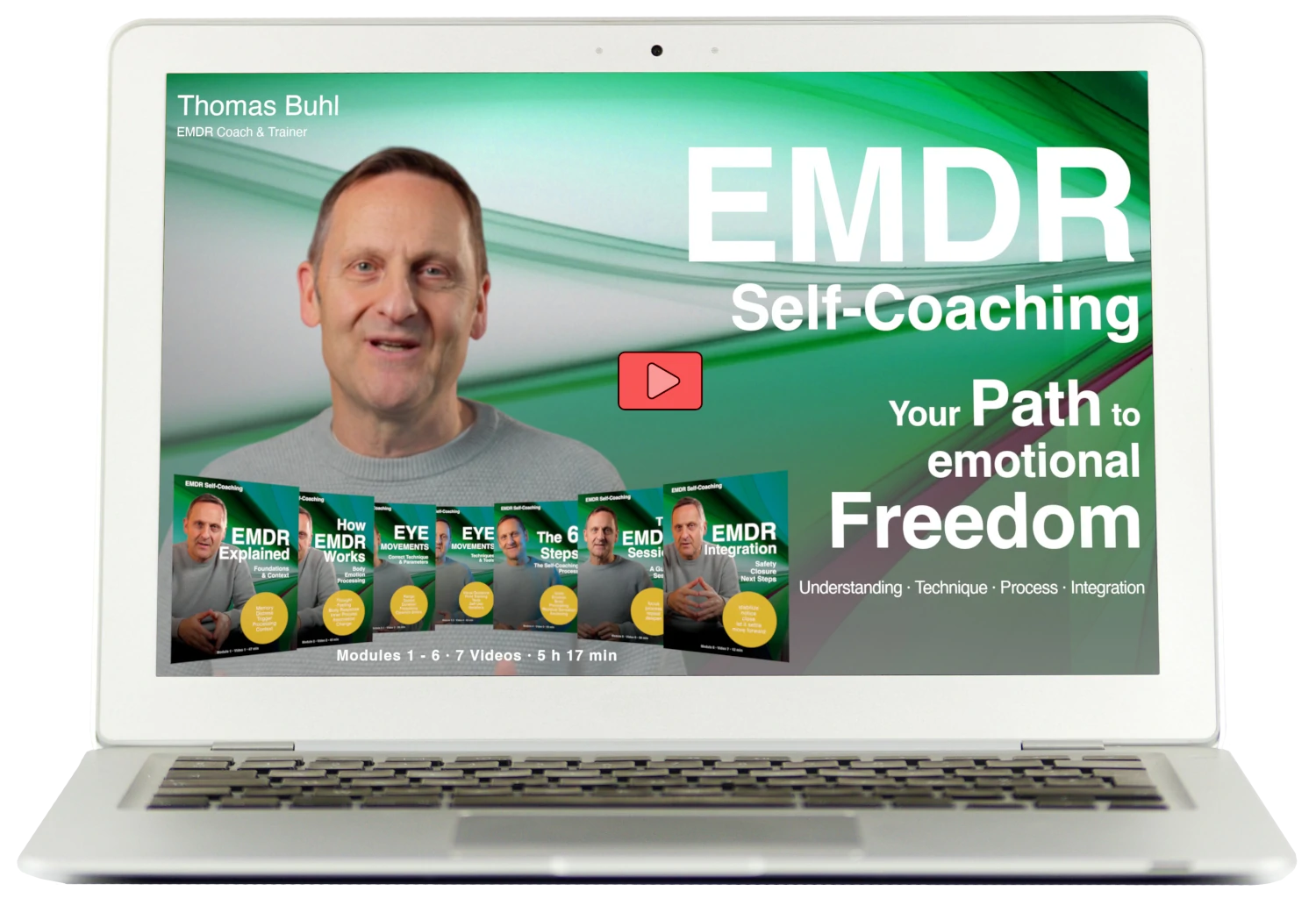
For limited, manageable, and non-pathological everyday stressors, EMDR self-coaching can be a complementary approach. Its potential point of reference would be the distressing meaning of that particular message, along with the associated emotion and physical reaction. The goal is not to force an end to your love or to prove that a breakup is the right thing to do.
To practice EMDR on your own, you must have learned the complete process and its limitations and be mentally stable enough to do so. If you face ongoing danger, overwhelming stress, or pressures that you can no longer manage on your own, seeking professional help should be your top priority. You may stop a session at any time. This article is not a guide for performing EMDR.
You don’t need to make a heartless decision
Letting go emotionally doesn’t mean you’re only allowed to feel relief before taking each next step. Sadness, affection, and doubt can all be present as you take seriously your already recognized desire for distance.
For your next supportive conversation, one sentence may be enough: “I know that I want to let go. It always gets hard for me when …” Fill in the specific situation. That way, the support can address your actual difficulty, rather than having to renegotiate your decision from scratch every time your feelings change.