


You can tell whether a relationship is harmful to you by looking at your recurring interactions with each other rather than relying on the word “toxic.” Can you express disagreement, maintain your own social connections, and set boundaries without being belittled or intimidated? Are your concerns taken seriously, and does anything change afterward? Observations like these help you assess the situation. You don’t need a diagnosis of your partner to take a difficult situation seriously or to seek support.

You might notice that you no longer mention getting together with friends without hesitation. You think ahead of time about which explanation will cause the least trouble. A single uncomfortable conversation doesn’t say much about the relationship as a whole. But if you regularly give up your own plans to avoid criticism or control, it’s worth taking a closer look.
What does “toxic” mean in a relationship?
In everyday life, the term describes a relationship in which the partner’s behavior repeatedly hurts or restricts you. It is not a psychological diagnosis. Nor does it explain why someone behaves that way. For your own guidance, a concrete description is therefore more helpful than searching for the right personality label.
“I’m made to look ridiculous in front of others when I have a different opinion” can be examined more closely than “My partner is toxic.” By saying this, you’re describing a behavior and its consequences. You don’t have to prove intent or decide whether the other person is good or bad overall.
What observations reveal a pattern
Pay attention to what happens repeatedly and how much freedom you have in your daily life. For example:
- Your own wishes are regularly ridiculed or used against you.
- You must account for your contacts, whereabouts, or private messages.
- A clear “no” is ignored; afterward, you’re expected to feel responsible for the other person’s reaction.
- After an offense, there’s an apology, but the same behavior happens again the next time.
These examples aren’t a multiple-choice test. What matters most are the context, the extent, and the consequences. How does the other person react when you want to do something differently? Is your objection heard, or do you end up having to withdraw it just to keep the peace?
Fear of the other person’s reaction can manifest, for example, as nervousness before a conversation. Perhaps you second-guess every sentence or cancel a meeting even though you would have liked to attend. This deserves attention. However, your nervousness alone does not prove a specific cause; what was actually said and done remains just as important.
A conflict leaves room for disagreement
Even in a respectful relationship, people can become impatient, misunderstand each other, or argue unfairly. An important distinction becomes clear: Can both people take responsibility for their behavior? Is it possible to resolve the issue? Will the agreements reached be taken into account next time?
If, on the other hand, you have to expect humiliation, intimidation, or punishment as soon as you step out of line, that space for freedom is missing. In that case, it’s not enough to simply work on phrasing your wishes more skillfully. You are not responsible for preventing another person’s abuse through perfect behavior.
Furthermore, you don’t have to wait for further incidents if violence, a threat, or coercion has already occurred. Even a single incident may require protection and support.
Support is available even when you’re unsure
A trusted person or a counseling center can help you make sense of specific incidents. It’s okay to say, “I don’t know what to call it yet. This is what happened, and this is how it’s affecting me.” To seek counseling, you don’t have to make a final judgment about the relationship or have already decided to break up.
In cases of violence, threats, stalking, coercion, or excessive control, protection and professional help take priority. In the event of an immediate threat, you can reach the police in Germany by dialing 110. The “Violence Against Women” helpline provides counseling to affected women at 116 016 around the clock, free of charge, and anonymously if desired. Regardless of your gender, you can contact local domestic violence or victim assistance centers.
Finding inner peace does not change the other person’s behavior
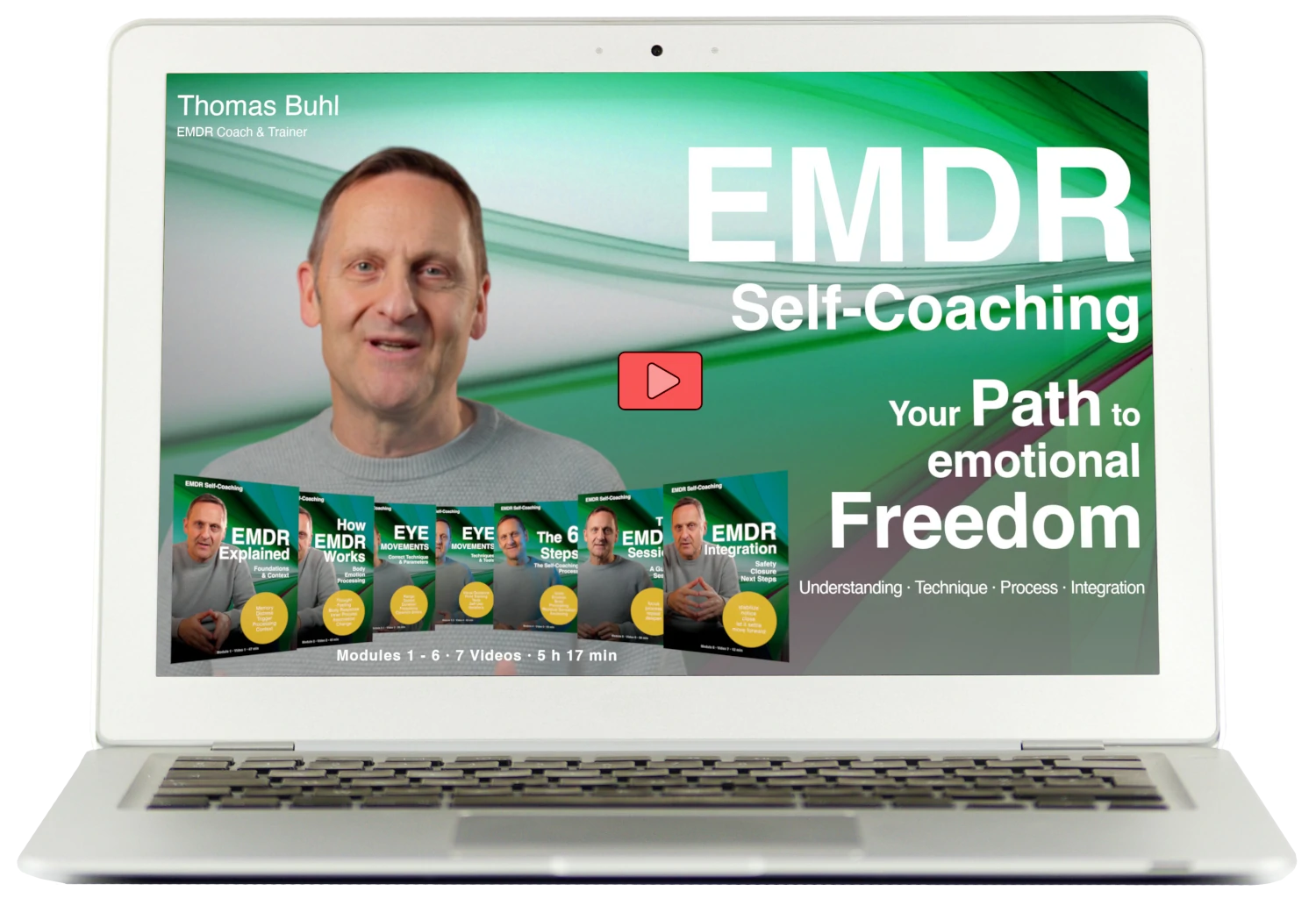
Thomas Buhl, an EMDR and trauma therapist, has developed his own six-step approach to EMDR self-coaching. It is designed to address limited, manageable, non-pathological everyday stressors. It cannot be used to resolve a stressful relationship or a threatening situation.
Only once the external situation is safe and you are sufficiently stable can a single internal aftereffect be considered as a potential issue—such as the tension you feel when recalling a specific sentence. Applying EMDR to yourself in this context does not mean suppressing legitimate warning signals in order to be able to endure more. In cases of severe or persistent distress, professional support is recommended; self-coaching is not a substitute for therapy.
To help you assess your relationship, it’s helpful to ask yourself one specific question: What actually happens when you express a personal desire? If you’re revealing less and less of yourself out of fear of the response, that’s exactly where you can start a confidential counseling session.