

If you ’re having trouble getting started on your thesis or term paper, check to see if there’s a subject-specific question you haven’t addressed yet, or if you ’re already judging your rough draft as if it were a finished paper. Missing arguments and unclear requirements call for objective support. EMDR Self-Coaching can, on the other hand, address the limited stress you feel when looking at the blank document: the thought “My start will be bad,” the tension, and the impulse to avoid it again.

There are annotated academic texts on the table. Your reading list has grown, and you have a preliminary outline. You know which section each set of notes belongs to. The only thing missing is the actual text of your paper. Before you start writing a paragraph, you’d rather open one more source.
Maybe you know that moment: You start to type a sentence, it sounds awkward, and before you know it, you’ve deleted it. Your hands hover over the keyboard. The weeks until the deadline are dwindling, yet you’re still waiting for a beginning that doesn’t sound like you’re just getting started.
Collecting source material and developing a text are two different tasks
Research may be necessary. If you haven’t yet narrowed down the topic or can’t support a key point, you need further clarification. The fact that you haven’t started writing a continuous passage yet doesn’t automatically mean you’re experiencing an emotional writer’s block.
But ask yourself specifically what the next source is supposed to answer. Do you have an open-ended question about the content, or do you want to feel fully prepared before you start writing? Without a clear search question, every additional article you read can give you yet another reason not to start writing your own text.
When writing a longer academic paper, some things only become clear as you put them into words. You notice where an argument is missing or where two terms don’t fit together. A rough draft reveals such gaps. This doesn’t mean you should leave unsubstantiated statements in the final version. It means that the working draft serves a different purpose than the final submission.
Start where a thought already exists
You don’t have to start the writing process with the introduction, which comes later. Choose a section for which you already have material. First, identify the specific question that this section is meant to answer. That way, you won’t be faced with the entire thesis all at once.
Then rephrase an existing idea in your own words and cite the appropriate source. You can clearly mark any unresolved issues in the working draft. A clearly marked placeholder is more honest than a phrase that feigns certainty, and more helpful than deleting the entire paragraph.
Revision is still planned. You’re not putting off the work—you’re just setting aside the right time for it. In the first draft, you check to see if an idea is on paper. Later, you examine more closely whether the argument, evidence, and wording hold up.
If you’re unsure about what academic argumentation requires in your field, your advisor or the writing center can help. Narrowing down a question that’s too broad is also part of academic work. Neither a more lenient approach to the draft nor a sense of relief can replace this clarification.
Why You Might Not Want to Leave That Unfinished Paragraph As Is
Maybe you’ve long understood the difference between a draft and a final version. Still, reading your first few sentences makes you break out in a sweat. “It can’t sound like this.” Or: “If even the beginning is bad, I won’t be able to finish this.” Then you’re not just evaluating a single phrase. You’re already expecting it to spell the failure of the entire project.
Returning to literature can be a relief at this moment. There, you find completed texts; your own attempt remains unseen. It is therefore worth capturing that exact transition: You read your first sentence, feel tension, and tap into a new source without having a new academic question.
Poorly worded text can be revised. The fear of even seeing it in front of you is a different matter. Making this distinction allows you to take both seriously without turning the entire process into a test of your suitability.
The Blank Document as a Limited Point of Reference
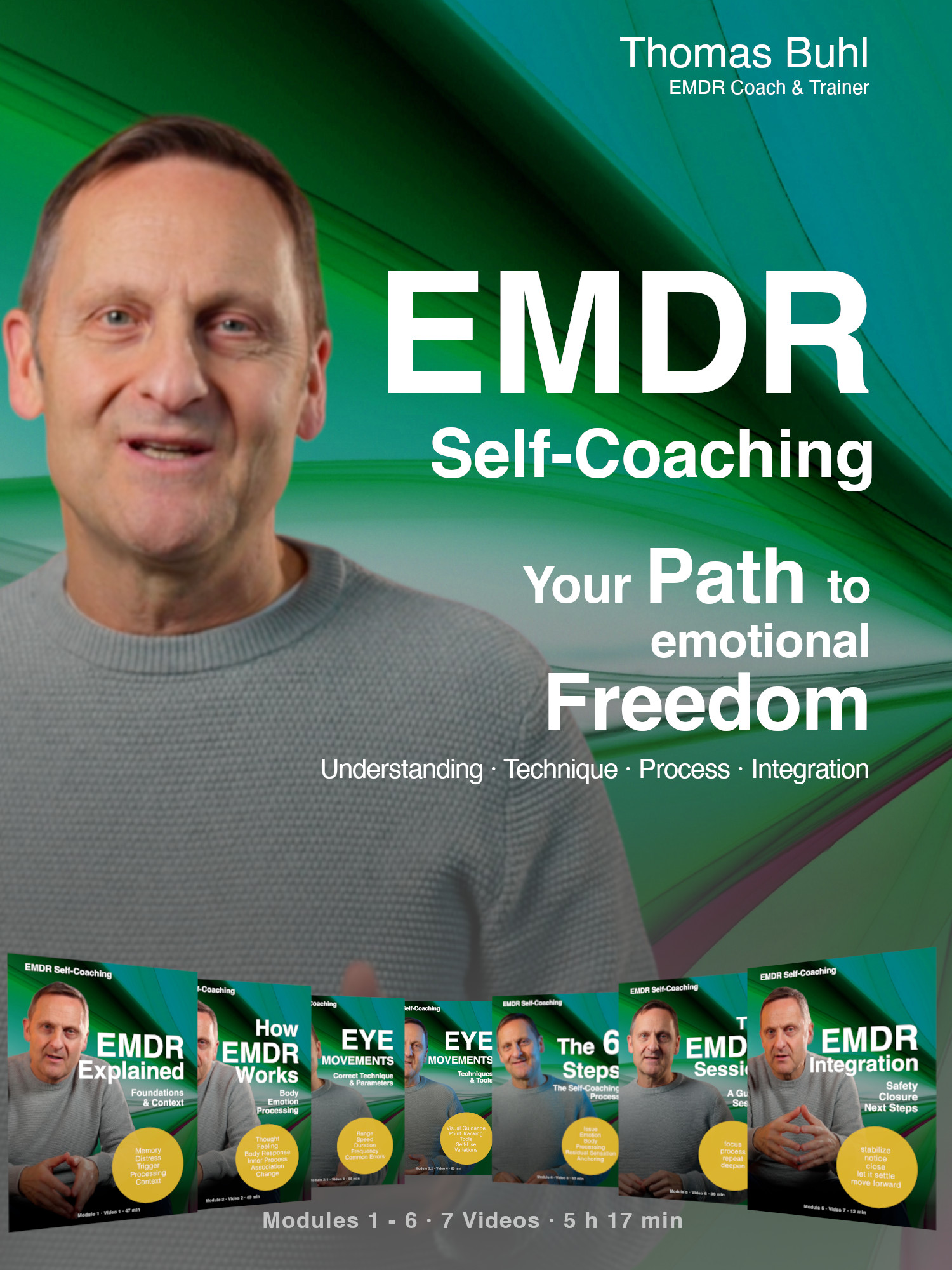
In the tutorial on the six-step model he developed himself, Thomas Buhl also describes upcoming tasks as possible topics. You don’t need a dramatic memory for this. Simply looking at the still-blank section and thinking, “I’m going to have a hard time getting started,” can be enough to accurately describe your current experience.
In EMDR self-coaching, the focus is on the associated emotion, the tension, and the urge to distract oneself. In the full process, the chosen topic is combined with bilateral stimulation. Any potential change relates to your stress response, not to the scientific quality of the resulting text.
If you want to use EMDR at home, limit yourself to appropriate, manageable, and non-pathological everyday issues. Learn the method thoroughly; this guide is not a practical session manual. If you feel overwhelmed, you should stop and seek support. Mental illness or overwhelming stress requires professional guidance, not self-coaching under time pressure.
A working draft may leave questions unanswered
Then return to the selected section. Formulate a coherent thought, add the existing evidence, and identify what is still missing. This will help you determine whether you should continue writing or clarify a specific issue.
The benchmark for this stage of work isn’t whether the sentences already look ready for print. What matters is whether you’ve created something you can continue working on. A paragraph with a clearly marked gap will help you make more progress in your field than a blank section that can’t yet contain any errors.